Comparing SUSY Multiplets: N=1, N=2, and N=4
A supersymmetry multiplet is a set of fields or states related by supercharges. The simplest matter example contains a complex scalar and a Weyl fermion, a spinor in one of the two chiral Lorentz representations in four dimensions. Supersymmetry transforms the scalar into the fermion and the fermion into derivatives of the scalar. The four-dimensional component lesson shows this mechanism with explicit transformations and checks the free action.
The comparisons below concern massless propagating field multiplets with spin at most one, unless a different setting is stated. They help identify a theory’s ingredients; a list of ingredients does not establish its invariant action. For explicit four-dimensional spinor conventions, begin with Weyl spinors and the algebra.
Count supercharges after specifying the dimension
Section titled “Count supercharges after specifying the dimension”The symbol counts copies of a minimal spinor supercharge. The number of real components in that spinor depends on dimension.
| Lorentzian spacetime | |||
|---|---|---|---|
| Three dimensions | 2 real supercharges | 4 | 8 |
| Four dimensions | 4 real supercharges | 8 | 16 |
These are Poincaré supercharges. A superconformal theory has additional conformal supercharges, counted separately. The integer in a gauge group such as is instead a color-space dimension; its rank is . The rank of is . Neither integer counts supersymmetry.
In particular, and have different numbers of real supercharges. Ordinary reduction with no supersymmetry lost instead pairs
Here reduction means keeping fields independent of the reduced spatial coordinate. A finite-radius quantum compactification, with its massive modes and possible nonperturbative effects, requires more information. A twist also changes the construction. The elementary reduction and three-dimensional algebra are described in Aharony et al., §2, (2.1).
In the optional quantum-mechanics setting, one complex charge and its adjoint correspond to two real Hermitian generators. We state that count directly rather than importing a three- or four-dimensional meaning of . Euclidean continuation likewise needs a separate reality prescription; independent barred variables do not double the parent theory’s Lorentzian supersymmetry.
Four-dimensional propagating fields
Section titled “Four-dimensional propagating fields”A gaugino is the spinor partner of a gauge field. All fields in a Yang–Mills vector multiplet transform in the adjoint representation. Matter multiplets can carry other gauge representations.
The following counts are numbers of real on-shell degrees of freedom: a real massless scalar contributes one, a complex scalar two, a four-dimensional gauge field two transverse polarizations, and a Weyl field two fermionic degrees of freedom. The Weyl field and its conjugate describe one independent Weyl field, including the appropriate particle and antiparticle states.
| Four-dimensional multiplet | Independent propagating fields | Bosonic / fermionic |
|---|---|---|
| chiral | One complex scalar; one Weyl fermion | |
| vector | One gauge field; one Weyl gaugino | |
| vector | One gauge field; one complex scalar; two Weyl gauginos | |
| full hypermultiplet | Two complex scalars; two Weyl fermions | |
| vector | One gauge field; six real scalars; four Weyl gauginos |
For a vector multiplet these counts are per gauge generator. An adjoint therefore multiplies them by ; a adjoint by . For a chiral in a representation , multiply by . A full hypermultiplet built from and its conjugate has bosonic and the same number of fermionic degrees of freedom. Do not multiply that last count by the representation dimension twice.
These are massless counts after constraints and equations of motion. They are not the number of unconstrained entries in a spacetime field. Bilal, §3.3, (3.7)–(3.11) and the following multiplet discussion constructs the corresponding massless representations.
The same fields in a smaller supersymmetry language
Section titled “The same fields in a smaller supersymmetry language”Choose an subalgebra of a four-dimensional theory. Its vector multiplet separates into an vector and an adjoint chiral:
The symbol here describes the organization of fields under the smaller algebra. It does not claim the two parts are decoupled theories. A full hypermultiplet instead becomes two chirals,
With one adjoint full hypermultiplet, the vector supplies the fields of Yang–Mills:
The interactions must have the appropriate couplings to realize the full supersymmetry. Three arbitrary adjoint chirals added to an vector do not by themselves establish . The component organization and the required interacting construction appear in Tachikawa, §2.1, (2.1.10)–(2.1.18).
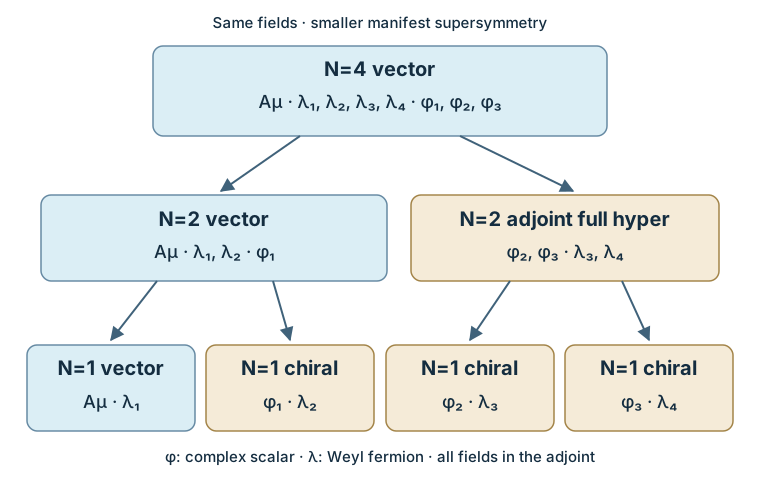
The count is now visible: the vector contributes , and three chirals contribute , giving . In language the same sum is .
Why a full hypermultiplet uses conjugate representations
Section titled “Why a full hypermultiplet uses conjugate representations”For a complex representation , write as a column and as a row:
The complex scalars and are independent. The second scalar is not constrained to be . Their contraction is gauge invariant, while and both transform in and form the scalar doublet under the symmetry. This distinction between the independent fields and the doublet’s use of a conjugate is explicit in Tachikawa, (2.1.12)–(2.1.13).
For the adjoint, is equivalent to , so the two chirals can both be called adjoint chirals. That special case must not be generalized to an arbitrary complex representation. Matrix-valued matter explains these contractions and their two-node versions.
Advanced distinction: a half-hypermultiplet
A pseudoreal representation admits an invariant antisymmetric pairing together with a compatible antilinear structure. It can support a half-hypermultiplet, with half the field content of the full hypermultiplet counted above. This is not an arbitrary deletion of one chiral in a complex representation. Consistency of a gauge theory also requires its anomaly constraints; the representation condition alone does not establish them. See Tachikawa, (2.1.19). The beginner table uses full hypermultiplets throughout.
Auxiliary fields are a different count
Section titled “Auxiliary fields are a different count”An auxiliary field has an algebraic field equation and no kinetic term producing an independent propagating mode. Off-shell closure means that successive supersymmetry transformations obey the algebra without imposing field equations.
| Multiplet in four dimensions | Auxiliary content | What it accomplishes |
|---|---|---|
| chiral | One complex | Adds two real bosonic components for off-shell closure |
| vector | One real | Completes the off-shell vector multiplet |
| vector | Three real auxiliary components, represented by one real and one complex in notation | Completes the ordinary off-shell vector multiplet; a covariant R-symmetry triplet can require field-dependent redefinitions |
For an chiral, the unconstrained Weyl field has four real component functions, and has four real bosonic component functions. On shell the counts become the of the first table. For a vector, count four components of minus one gauge redundancy, plus : four bosonic components match the unconstrained gaugino’s four. This local off-shell count is distinct from the two transverse modes of an on-shell photon.
For example, Bilal’s interacting vector action, (8.7) contains, in his normalization, , where is his adjoint complex scalar and his gauge coupling. Completing its real-auxiliary square shifts to . Calling the raw entries a covariant triplet would miss this field-dependent change in the non-Abelian interacting case.
Choosing finitely many auxiliaries for an description of a hypermultiplet or theory establishes off-shell closure only for that chosen subalgebra. It does not prove finite-auxiliary off-shell closure of all the extended supercharges.
Keep gauge, flavor, and R-charges separate
Section titled “Keep gauge, flavor, and R-charges separate”A gauge representation specifies how a field transforms under local gauge transformations. A flavor symmetry acts on matter and commutes with the supercharges. An R-symmetry acts nontrivially on the supercharges; its component charges therefore change along a multiplet.
Let be a Grassmann-odd spinor coordinate used to package the component fields. For the conventional choice , expand a chiral superfield schematically as . If has R-charge , every term must have that same charge:
| Component | Gauge representation | Flavor charge | R-charge |
|---|---|---|---|
| in a vector | Adjoint | for the matter flavor symmetry | |
| Gaugino | Adjoint | ||
| Vector auxiliary | Adjoint |
The conjugate components have conjugate gauge representations and opposite Abelian charges. The is a chosen subgroup when the full theory has an extended R-symmetry.
For example, the theory in notation has a cubic superpotential proportional to . Since a superpotential has R-charge two, the symmetric assignment is . The three chiral fermions then have charge , while the vector gaugino has charge . This is a choice of manifest R-generator inside the extended symmetry, not four identical component charges.
An automorphism of a supersymmetry algebra need not survive as a symmetry of a chosen interacting action, and a classical R-symmetry can have an anomaly. The R-symmetry lesson and superpotential example distinguish these questions.
Three dimensions: the extra vector scalar
Section titled “Three dimensions: the extra vector scalar”Under zero-mode reduction of a four-dimensional gauge field, separates into a three-dimensional gauge field , , and a real adjoint scalar . Gauge transformations independent of the reduced coordinate act on by conjugation. The scalar is therefore part of the reduced vector multiplet.
| Three-dimensional multiplet | Independent propagating fields | Bosonic / fermionic |
|---|---|---|
| chiral | One complex scalar; one complex two-component fermion | |
| Yang–Mills vector | Gauge field; real scalar; one complex two-component gaugino | |
| Yang–Mills vector | Gauge field; three real scalars; two complex two-component gauginos | |
| full hypermultiplet | Two complex scalars; two complex two-component fermions |
A massless three-dimensional Yang–Mills gauge field has one local polarization. Thus and give bosonic degrees of freedom, matching the reduced four-dimensional vector. A three-dimensional complex two-component fermion has two real on-shell degrees of freedom. The vector’s scalar origin is stated in Aharony et al., §2.2 before (2.5).
These Yang–Mills counts do not apply unchanged to a pure Chern–Simons vector multiplet. A Chern–Simons gauge field has no local Maxwell-like photon polarization, and the extra vector components in the usual supersymmetric Chern–Simons action are auxiliary.
For example, standard ABJM has gauge group . In manifest notation it has two Chern–Simons vectors and four chirals: in and in . The full supersymmetry is , or twelve real Poincaré supercharges, while four are manifest in this notation. ABJM, §2.1–2.2, (2.1)–(2.6)
At the standard theory has enhanced , or sixteen real supercharges; monopole operators enter the extra current multiplets. This enhancement is supported by Bashkirov–Kapustin’s analysis, abstract and introduction, beyond the enhancement conjecture in the original ABJM discussion. The dimension, level and global gauge group remain part of the theory’s specification. Equal numbers of real supercharges do not identify this three-dimensional theory with four-dimensional Yang–Mills.
Other uses of the word multiplet
Section titled “Other uses of the word multiplet”The tables organize elementary massless fields. A current multiplet instead packages conserved currents and related local operators; the central paper’s R-multiplet belongs here. Its couplings to background sources identify its physical operators. Its stress tensor and supercurrents are not extra elementary particles to add to a vector’s count.
A massive particle multiplet is a representation at timelike momentum, with a different little group and possible shortening when a central-charge bound is saturated. A superconformal operator multiplet organizes operators under conformal generators and supercharges, with primaries, descendants and shortening conditions. Finally, the general component multiplet in the central paper, (6.3)–(6.4), is a transformation package from which constrained multiplets can be obtained. Each use specifies a different object; counting the entries of one does not count the physical states of another.
Three quick checks
Section titled “Three quick checks”1. Reconstruct the N=4 count
Section titled “1. Reconstruct the N=4 count”Use the decomposition to recover both the field list and the count for one gauge generator.
Solution
The vector contributes , with two bosonic and two fermionic on-shell degrees of freedom. Three chirals contribute three complex scalars, or six real scalars, and , with six fermionic degrees of freedom. Hence in both sectors. The auxiliaries are excluded from this on-shell count. Multiplying by supplies the color multiplicity without changing .
2. Find the lost polarization
Section titled “2. Find the lost polarization”A proposed reduction deletes and keeps only and the reduced gaugino. Why does this fail to reproduce the ordinary reduced vector multiplet?
Solution
The four-dimensional photon has two polarizations. The three-dimensional photon has one, while the reduced complex gaugino retains two real on-shell degrees of freedom. The zero mode of supplies the missing real scalar, restoring . Deleting it changes the field content and is not ordinary supersymmetry-preserving reduction. At finite compactification radius its gauge-invariant interpretation involves holonomy; the local zero-mode argument does not determine all its global identifications.
3. Test a proposed hypermultiplet contraction
Section titled “3. Test a proposed hypermultiplet contraction”Let both be fundamentals of . Use to test the proposed invariant . Compare it with for an independent anti-fundamental row .
Solution
For , the proposed contraction starts at one and becomes . It is not gauge invariant. An anti-fundamental instead transforms as , so for every . This explains the conjugate representations in a full hypermultiplet. It does not require ; the two scalar fields remain independent.